


What Is a Remote Reservoir Shock? How It Works & Why It Matters for Off-Road Performance
If you've been shopping for aftermarket suspension for your truck or SUV, you've probably come across the term remote reservoir shocks. They're commonly found on higher-performance off-road suspension systems, but what exactly makes them different from a standard shock absorber?
A remote reservoir shock is designed to handle the additional demands of off-road driving by increasing fluid capacity, improving heat management, and providing more flexibility in shock design. These advantages can make a noticeable difference when driving over rough terrain, navigating washboard roads, or spending extended time on the trail.
Whether you're upgrading your Toyota Tacoma, 4Runner, Ford Bronco, or another 4x4, understanding how remote reservoir shocks work can help you choose the right suspension for your vehicle and driving style.
Let's break down what a remote reservoir shock is, how it works, and why it's worth considering for your next suspension upgrade.

1. What Is a Remote Reservoir Shock?
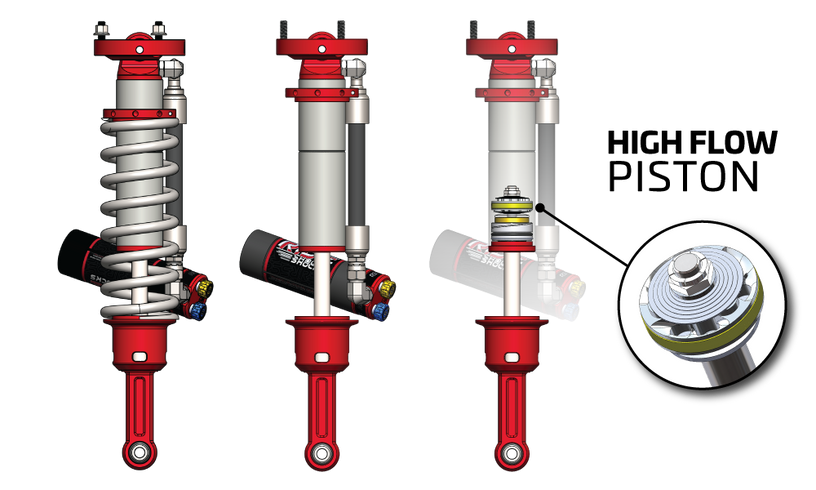
A remote reservoir shock is a type of shock absorber that uses an additional external chamber connected to the main shock body through a high-pressure hose.
Unlike a standard shock that houses its internal components within the main shock body, a remote reservoir design moves part of the shock's internal system into a separate external chamber.
This additional reservoir provides more room for shock oil and nitrogen gas, allowing the shock to manage heat and fluid movement more effectively during demanding driving conditions.
Remote reservoir shocks are especially popular in off-road applications because they can provide more consistent damping performance during repeated suspension movement.
You'll typically find them on:
-
Off-road trucks and SUVs
-
Overland and adventure vehicles
-
Desert racing and prerunner builds
-
Rock crawling and trail rigs
-
Vehicles carrying additional accessories and equipment
 2. How Does a Remote Reservoir Shock Work?
To understand the benefits of a remote reservoir, it helps to understand what's happening inside a shock absorber.
A shock absorber controls how quickly your suspension compresses and rebounds. As your tires encounter bumps, rocks, and uneven terrain, the shock's internal main piston moves through hydraulic oil.
The oil is forced through small passages and valves inside the shock. This controlled movement creates resistance, known as damping, which helps control unwanted suspension movement.
 However, repeatedly cycling a shock generates heat. As temperatures increase, the properties of the shock oil can change, potentially affecting damping performance.
This is where the remote reservoir comes into play.
The external reservoir provides additional space for oil and houses a floating piston that separates the hydraulic oil from pressurized nitrogen gas.
As the shock compresses, the shock shaft displaces oil. That displaced oil moves through the connecting hose and into the reservoir, allowing the floating piston to move and accommodate the changing oil volume.
When the shock extends, the process reverses.
This design provides additional fluid capacity and helps manage the heat generated during repeated suspension movement.

3. What Are the Benefits of Remote Reservoir Shocks?
Remote reservoir shocks offer several advantages over more basic shock designs, particularly when used for demanding off-road applications.
Increased Oil Capacity
One of the biggest advantages is the additional oil capacity.
More oil provides greater thermal capacity, meaning the shock can absorb more heat before experiencing the same temperature increase as a smaller-volume system.
This is especially beneficial when driving over repeated bumps, washboard roads, and rough terrain where your suspension is constantly working.
Improved Heat Management
Heat is one of the biggest challenges when it comes to shock performance.
As shock oil gets hotter, its viscosity changes, which can affect how the shock responds to suspension movement.
The additional oil volume and reservoir surface area help manage heat and support more consistent damping during extended off-road driving.
More Consistent Damping Performance
When shocks get too hot, they can experience what's commonly called shock fade.
Shock fade occurs when the shock can no longer maintain its intended damping characteristics due to excessive heat, aeration, or other operating conditions.
Remote reservoir shocks help reduce the likelihood of performance degradation during repeated, demanding suspension cycles.
This is particularly important for drivers who regularly encounter rough trails, desert terrain, and high-speed off-road conditions.
More Suspension Design Flexibility
Moving part of the shock's internal system into an external reservoir gives engineers additional flexibility when designing the main shock body.
Depending on the application, this can allow for different shaft sizes, shock lengths, internal configurations, and external adjustment features.
The reservoir itself doesn't automatically increase suspension travel. Travel still depends on the shock's dimensions, shaft stroke, and vehicle suspension geometry.

4. Remote Reservoir vs. Standard Shocks
So how does a remote reservoir shock compare to a standard shock?
The biggest difference is how the shock manages its internal oil and gas, along with the additional design flexibility provided by the external reservoir.
A standard internal floating piston (IFP) shock houses its floating piston and nitrogen chamber inside the main shock body.
A remote reservoir shock moves that floating piston and nitrogen chamber into an external reservoir connected to the shock through a hose.
Here are a few key differences:
|
Feature |
Standard IFP Shock |
Remote Reservoir Shock |
|
External reservoir |
No |
Yes |
|
Oil capacity |
Generally lower |
Generally higher |
|
Heat management |
More limited |
Greater thermal capacity |
|
External adjusters |
Depends on design |
Often available |
|
Packaging flexibility |
More limited |
Greater design flexibility |
|
Off-road applications |
Light to moderate use |
Moderate to demanding use |
Not every remote reservoir shock is automatically better than every standard shock. Internal design, materials, valving, and tuning all play important roles in overall suspension performance.
The right shock is the one properly engineered and tuned for your vehicle, weight, and intended use.
5. What Is the Difference Between Remote Reservoir and Piggyback Shocks?
You may also come across the term piggyback reservoir when shopping for aftermarket suspension.
Both remote reservoir and piggyback shocks use an external chamber to increase fluid capacity and accommodate the nitrogen charge.
The main difference is how the reservoir connects to the shock.
Remote Reservoir Shocks
A remote reservoir uses a separate canister connected to the shock body through a high-pressure hose.
This allows the reservoir to be mounted independently of the shock body, providing additional flexibility for installation and packaging.
Piggyback Reservoir Shocks
A piggyback reservoir is mounted directly to the main shock body, creating a more compact assembly without a separate connecting hose.
Both designs can offer increased oil capacity and improved heat management compared to a basic shock design.
The better option depends on the vehicle's available mounting space, suspension configuration, and the shock manufacturer's design.
 6. Why Hose and Fitting Size Matter
Something that often gets overlooked when shopping for remote reservoir shocks is the size of the hose connecting the shock body to the external reservoir.
The hose is responsible for transferring shock oil between the main body and reservoir as the suspension cycles.
Its internal diameter can influence how easily fluid moves through the system, making hose and fitting design an important consideration in overall shock performance.
At Ride Shocks, we put considerable development into our reservoir hose and fitting design.
Our remote reservoir shocks use larger -10 (5/8-inch) hoses and fittings, compared to the smaller -8 (1/2-inch) connections commonly found on many competing designs.
The goal was to improve fluid flow between the shock body and reservoir while reducing a potential restriction in the system.
It's one of several details our engineering team focused on when developing the Ride Shocks lineup.

7. Why Ride Shocks Uses Remote Reservoir Technology
At Ride Shocks, we believe suspension should do more than simply increase ground clearance or make your vehicle look more aggressive.
It should improve the way your vehicle drives, whether you're commuting during the week, exploring forest roads, or spending the weekend navigating challenging off-road terrain.
Our 2.5-inch remote reservoir shocks are engineered and assembled by our team in San Diego, California, with a focus on ride quality, durability, and adjustability.
Here are a few features that set Ride Shocks apart.
2.5-Inch 6061-T6 Aluminum Shock Bodies
Our shock bodies and reservoirs are CNC machined from 6061-T6 aluminum and feature a hard-anodized finish for durability and corrosion resistance.
DPA Dual Piston Adjuster
Every Ride Shock comes standard with our patented DPA Dual Piston Adjuster.
This system provides independent high-speed and low-speed compression adjustment, with 12 clicks of adjustment available on each knob.
This allows you to fine-tune your suspension for different driving conditions.
-
Low-speed compression helps control suspension movement over gradual bumps, body roll, and additional vehicle weight.
-
High-speed compression helps control the shock's response to sharp impacts, larger bumps, and demanding off-road terrain.
Vehicle and Weight-Specific Tuning
We don't believe one shock setup works for every vehicle.
Added accessories, bumpers, roof racks, rooftop tents, camping equipment, and other modifications all change how your suspension performs.
That's why Ride Shocks are offered in different weight ranges and configurations to better match your vehicle's actual setup.
Built for the Long Haul
Every Ride Shock is backed by a 3-year / 50,000-mile warranty, giving you confidence in your suspension investment.

8. Are Remote Reservoir Shocks Worth It?
For many truck and SUV owners, remote reservoir shocks are a worthwhile upgrade, particularly if you regularly drive off-road or carry additional vehicle weight.
The increased oil capacity and improved thermal management can help maintain more consistent suspension performance during demanding driving conditions.
However, a remote reservoir isn't automatically necessary for every vehicle or driver.
If your vehicle spends most of its time on pavement and only occasionally encounters maintained dirt roads, a properly matched standard shock may be all you need.
If you regularly explore rough trails, travel through desert terrain, carry additional accessories, or want more suspension adjustability, remote reservoir shocks are worth considering.
Ultimately, the quality of the shock's internal design and how well it's tuned to your vehicle matter just as much as having an external reservoir.
Final Thoughts
Remote reservoir shocks are designed to handle the additional demands of off-road driving by increasing oil capacity, improving heat management, and providing greater flexibility in shock design.
But the reservoir is only one piece of the puzzle. Proper valving, vehicle-specific tuning, quality materials, and adjustability all contribute to how your suspension performs.
At Ride Shocks, we combine remote reservoir technology with our DPA Dual Piston Adjuster and vehicle-specific tuning to deliver suspension designed for real-world driving.
Because whether you're commuting to work, heading out for a weekend camping trip, or exploring challenging trails, ride quality matters most.
Explore the Ride Shocks lineup and find the right suspension setup for your vehicle.
Related Articles
April 15, 2024
Ride Shocks Features & Benefits

February 11, 2025
Ride Shocks: High Flow By Design
Contact Us
How Can We Help You Today?
The Ride Shocks team is available to answer fitment questions, assist with weight range selection, provide order status updates, and handle warranty claims. We're enthusiasts ourselves — we understand that getting the right suspension setup matters, and we'd rather take the time to answer your questions upfront than troubleshoot problems after the fact.
If you're unsure which weight range is right for your build, reach out before you order. Tell us your vehicle, trim, and all planned accessories and we'll point you to the correct configuration.